

Under the Skin
The photography of Jo-Anne McArthur and the hidden lives of animals

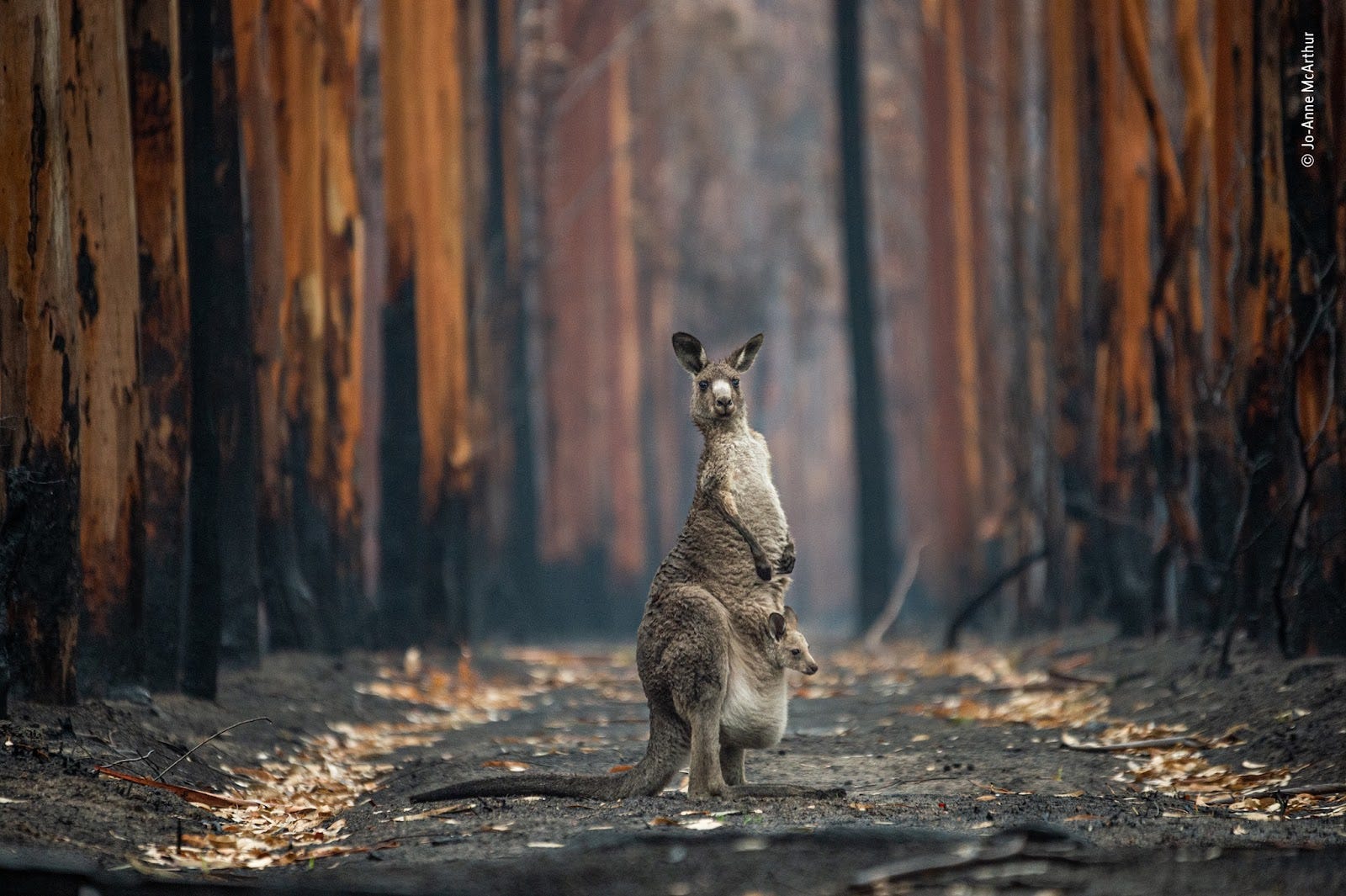
In Mallacoota, Victoria, amid the scorched remains of the 2020 bushfires, Jo-Anne McArthur spotted an eastern grey kangaroo with her joey. It was midday, the sky muted by clouds, and McArthur realized she would need to cover a long stretch of burned ground to frame the photograph she had in mind. She walked quickly, camera ready, hoping the animals would stay. By chance and persistence, they did. When she finally raised her lens, the mother paused long enough for McArthur to press the shutter—a fleeting moment against a backdrop of devastation. The resulting photograph, “Hope in a Burned Plantation,” would go on to become a symbol of both resilience and loss in the Anthropocene, earning wide international acclaim and a win in the Wildlife Photographer of the Year competition.
This scene represents just one moment in McArthur's two-decade journey as perhaps the world's preeminent animal photojournalist. The Canadian photographer and educator has traveled to more than sixty countries documenting the complex, often troubling relationships between humans and animals. She’s the founder of We Animals, a groundbreaking nonprofit and photojournalism project that has become the world’s leading archive of animal photojournalism. Over the past two decades, her images have been published in major outlets including National Geographic, The Guardian, and The Washington Post, and have been used by hundreds of NGOs and advocacy campaigns worldwide. She has published several acclaimed books, including We Animals and Hidden: Animals in the Anthropocene, and her work has earned her numerous international awards for both photography and animal advocacy. From slaughterhouses and factory farms to zoos, circuses, and wildlife markets, McArthur’s lens captures what most people never see.
A childhood of seeing
McArthur's path toward animal photojournalism began with seemingly small moments in her childhood. “When I was a child, on a rainy Sunday afternoon, once in a while [my mom] would say, ‘Let's go to the animal shelter,’” McArthur recalls. They weren't there to adopt; they were simply there to spend time with the animals and, perhaps, to bear witness. “I would leave crying. I think that really stayed with me, and I can thank her for that because I think it's one of the many things that made me the sensitive person that I am.” Her mother, a nurse who worked with children in operating and cardiac units, wasn't particularly focused on animal rights, but possessed a general empathy that McArthur credits as influential.
That sensitivity deepened when her mother moved to the countryside and, along with two dogs and a cat, kept 10 backyard chickens. “I had never spent time with chickens before. Chicken was my favorite food,” she says. “Getting to know chickens, I realized I couldn’t eat my favorite food anymore. It was a big shift for me, realizing that the animals I was eating were just as sentient as the wild birds I loved.”
McArthur’s formal journey into photography began in university. “I took a black-and-white printing course as an elective, and by the second class, I knew what I wanted to do for the rest of my life,” she recalls with a laugh. She became “singularly focused on educating myself, working with other photographers, and learning the skills of the trade.” She was especially drawn to conflict photography and the idea of bearing witness to injustice. “Who are these people who put their lives in jeopardy to go and expose something that needs to be seen, who make images that change the course of history?” she wondered.
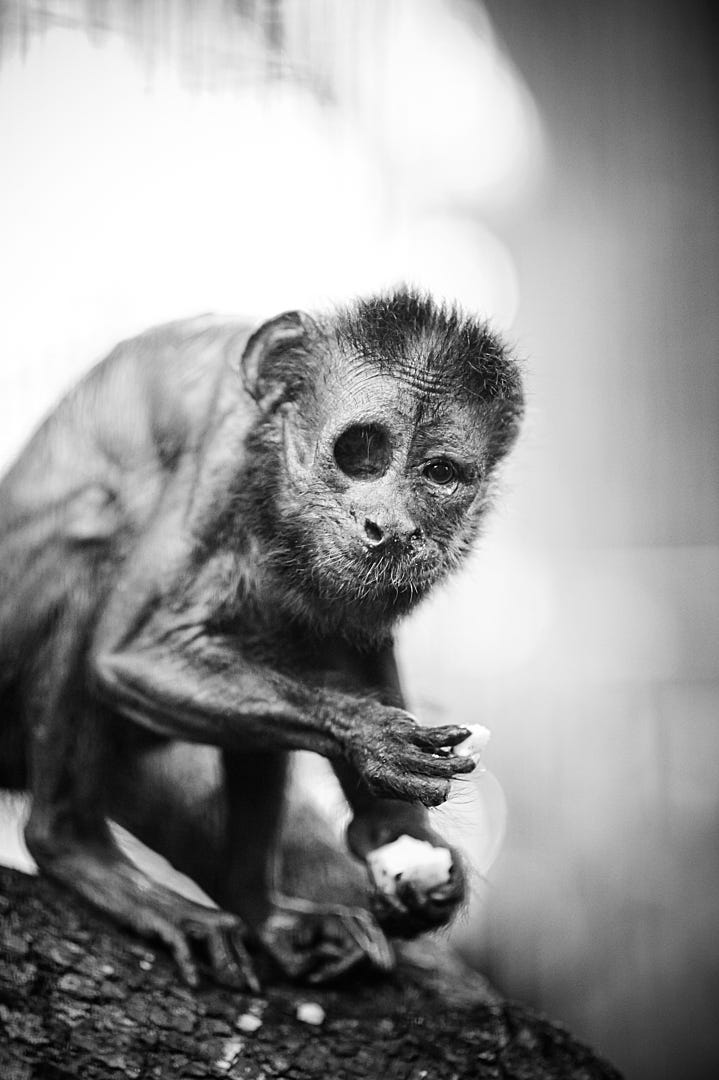
It was a trip to Ecuador in 1998 that crystallized her mission. While hiking, she saw a capuchin monkey chained to a windowsill. “I was taking a picture of this chained-up monkey, and so were other people. They thought it was sort of funny and cute, and they were taking tourist pictures, whereas I was taking pictures, thinking, ‘Maybe I can do something important with this picture, like change the fate of this monkey, launch some complaints.’ There’s a very clear tie there between photography and activism, and frankly, between photography and photojournalism. I think that’s, in part, what photojournalism is.”
Making the invisible visible
When McArthur enters a space—a factory farm, a roadside zoo, a slaughterhouse—she’s looking for more than just documentation. She’s after the whole story: “Some of my most successful images are shot with a wide angle and they show an entire system,” she explains. “You can't tell much of a story if you get a headshot of an animal. It might be a beautiful picture, but it doesn't say much.”
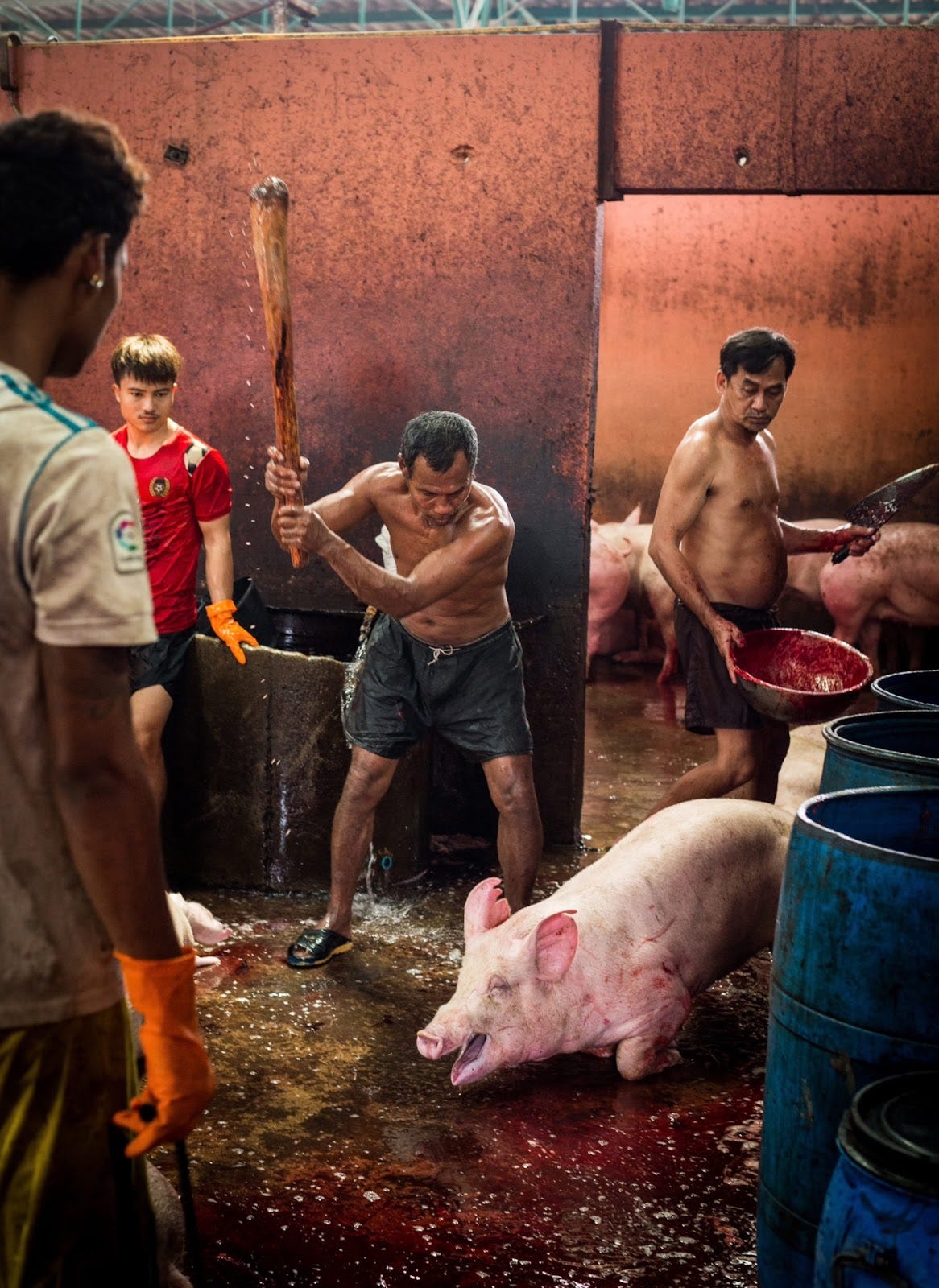
Her approach is rooted in photojournalism’s tradition of immersion and context. “We love wide-angle lenses. We want to quietly immerse ourselves in what's happening, and with a wide angle, you can photograph—like with the pig being clubbed [below], you can see it's a slaughterhouse. You can see what's happening and what’s going to happen. That image offers more of a story than if I’d shot it with a portrait lens.” She strives for images that capture not just the animal’s experience, but the system at work: “She's on her knees, she's screaming, her eyes are closed, and then the actions of the man holding a [club]—it's kind of a complete picture, and I strive for those.”
McArthur’s camera is her passport into otherwise closed worlds. “The camera is like my all-access pass into the lives of others,” she says. “Because I’m friendly and because I’m genuinely curious, that camera, that tool allowed me to go to all sorts of places—orphanages in Northern India, medical missions in Senegal, factory farms. Sometimes I show up at odd hours and ask workers who they are, and what's going on, and if I can come in and take pictures of this unusual thing happening.”
Her approach to documenting animal exploitation follows three primary methods. The first is what she calls “the easy way”: purchasing tickets to places where animal exploitation is commercialized, like circuses, rodeos, bullfights, zoos, and aquariums. “I really used to hate giving any money whatsoever to these companies,” she admits. “However, it’s a really good investment in animal advocacy if you leave with high-quality pictures that the world can see not only once, but see for decades.”
The second and much more difficult method involves undercover investigations. “You need a team, you need people with experience. You need walkie-talkies, you need a getaway car,” McArthur explains. These operations require careful planning to “as securely as possible trespass and go into a farm, document what you see, and leave with those very precious images.”
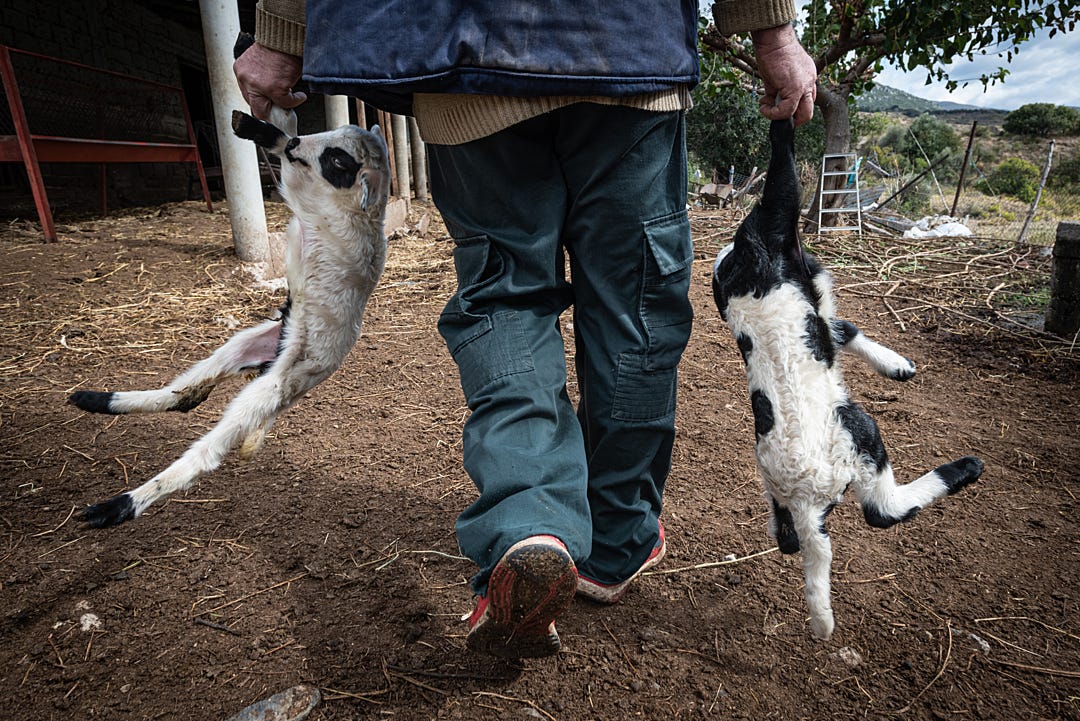
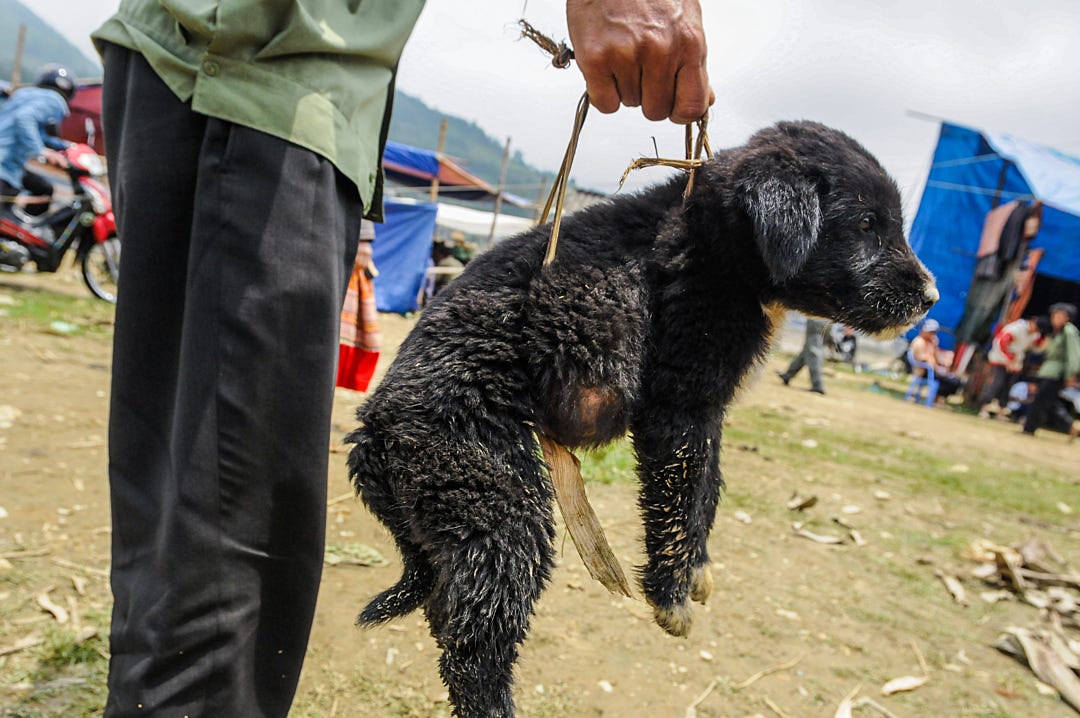
The third approach involves immersing herself in a location and following leads. “I remember landing in Hanoi, Vietnam, and staying at a little hostel and asking the people at the front desk, ‘Do you know who I could hire for a day to drive me around, to show me any place that animals are used?’” she recounts. “They’re like, ‘Yeah, our cousin, he’s going to show up early in the morning, 5 a.m., and he has a scooter.’ And off we went in the dark of the morning to go to where animals are processed—big places, backyard slaughterhouses, bear bile farming, traditional medicine types of places.”
Her work has exposed her not just to the suffering of animals, but also to the hardship and vulnerability of workers in the system. “The workers are there working very hard, getting injured themselves. So many farm workers are unpapered, making very little money and have no security. And here I am, this wealthy white girl with these big cameras—they might feel exposed. So I do my best to reassure them that I’m not there to show that they’re a bad person. On the contrary, I’ll do everything I can to show that I’m documenting this entire experience.”
Building an archive
Over the years, what began as a personal project for McArthur has evolved into We Animals, a nonprofit that maintains an internationally recognized archive and collective of animal photojournalism. The organization now holds the work of over 175 photographers around the world, each contributing their own perspective and expertise. The We Animals stock site contains some 35,000 images and videos, available for free for noncommercial use—a resource for NGOs, journalists, educators, and advocates worldwide.
Early on, she realized that too many of her images—often captured under difficult, sometimes dangerous conditions—were languishing unseen. “Too many images were just ending up on my hard drive. They weren’t out in the world.” She has since put together a small but dedicated and growing team of colleagues who do the work of compiling, captioning, and organizing the ever-growing archive. “The reason I do this work is to help as many animals as I can,” McArthur explains. “You have to reach as many people as you can to do that.”
The organization’s explicit advocacy stance sometimes creates barriers with mainstream media. In a conversation with a prominent international media outlet, McArthur recalls how she was told that despite the quality and importance of her work, they couldn’t use her images because “the byline is Joanne McArthur, We Animals, and We Animals is an activist organization.” Rather than hiding their advocacy, McArthur embraces it. “We do identify ourselves as [activists] because it’s the truth. Like, why hide from it? We are there to change things for animals, right? So we’re not gonna be shy about that.”
Bearing witness in Brussels
In March 2025, Jo-Anne McArthur traveled to Brussels for a milestone event: the unveiling of “The Hidden Costs of Factory Farming” at the European Parliament. The exhibition, organized by the European Institute for Animal Law & Policy and the European Environmental Bureau, brought together images from McArthur and other We Animals photographers, offering an unflinching look at industrial animal agriculture across the EU. For McArthur, it was her third visit to the Parliament in a decade, and her second time addressing Members of the European Parliament (MEPs) directly.
“I really appreciate when organizations that work in law and policy understand the importance of storytelling,” McArthur reflected afterward. She was keenly aware that the exhibit’s true power lay in its ability to bring lawmakers face-to-face with the realities they so often legislate from a distance: “People who are making decisions need to see what’s happening on the front lines. And that’s what we do. And that’s my weird-ass specialty: going to the front lines of animal suffering.”
The exhibition filled a high-traffic corridor with large-scale photographs—scenes of overcrowded barns, mutilations, and the daily routines of suffering that underpin Europe’s food system. McArthur addressed a room of policymakers and advocates, sharing both the stories behind the images and the urgency of their message. “I had a lot of positive feedback,” she said. “Now, it doesn’t mean that great change will come from the hundred attendees that I addressed…but an exhibit of this kind in the EP gets covered in the media and it generates a lot of interest.”
Yet, the atmosphere was tempered by political realities. In conversations with Parliament staff and attendees, McArthur sensed a shift. “Given the increase in right-wing representatives now and culture having shifted that way, generally they don’t feel optimistic that a lot of new laws and policies will be passed in this term,” she explained. With another four years before the next elections, many saw the need to focus less on immediate legislative wins and more on changing hearts and minds. “It was interesting to hear the policy people say that they really need to focus on culture change right now,” McArthur noted. For her, and for the artists and advocates present, this was a reminder that storytelling and cultural advocacy are not just complementary to policy—they’re essential to it.
For McArthur, being invited as a cultural representative made sense. “Stepping back from just photojournalism—we are artists, and that’s what artists do. They’re often the canary in the coal mine, and they’re often turning heads before anyone else is, saying ‘this is important, this is what we’re going to depict about culture at this time.’”
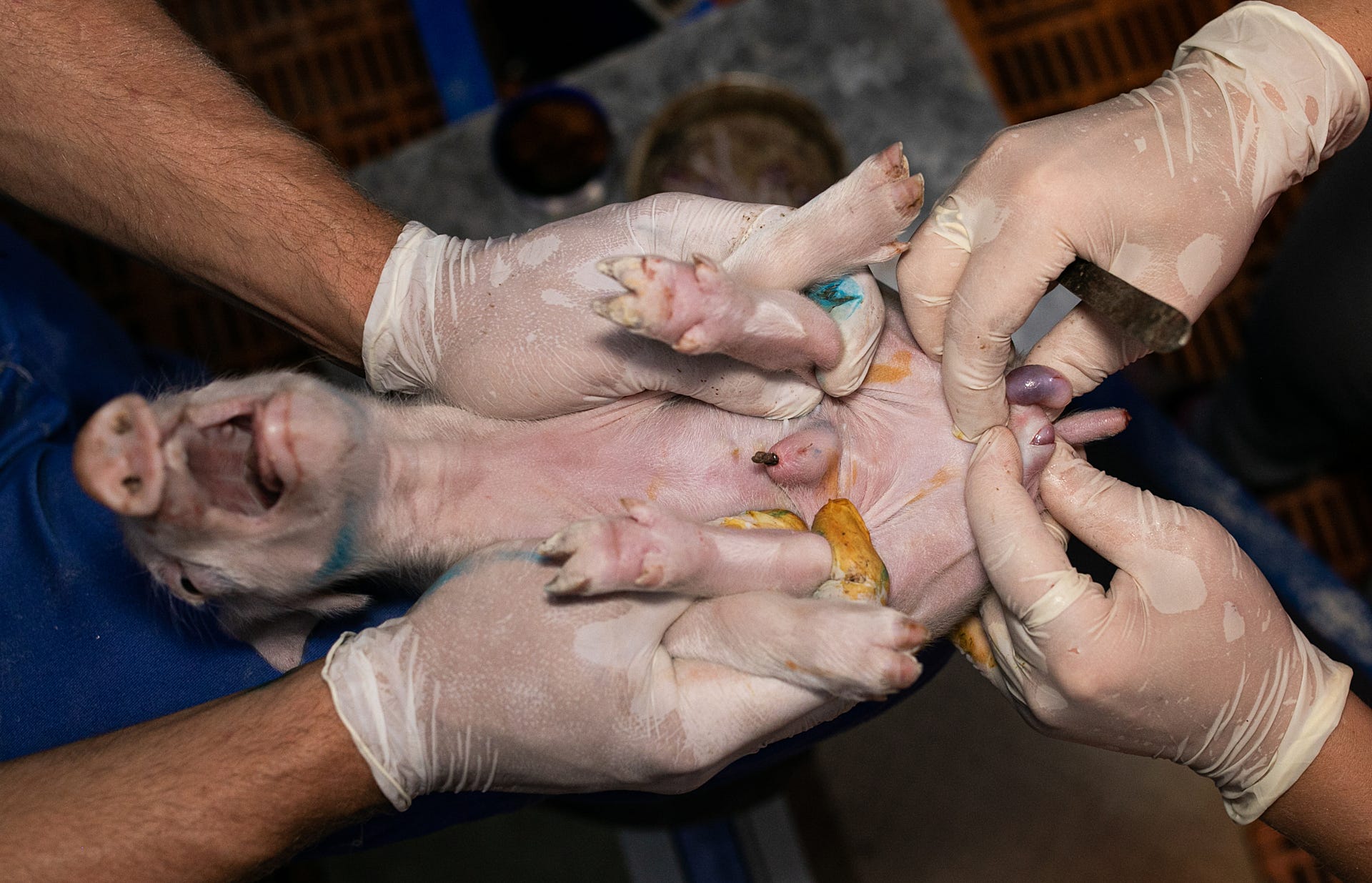
The exhibit itself sparked debate about what’s considered too graphic for public display. While many disturbing images remained on the walls for the duration of the event, a close-up photograph of a piglet being castrated without anesthetic—taken by Polish animal photojournalist Andrew Skowron—was singled out and removed at the request of a commissioner. The decision highlighted how certain forms of animal suffering, though routine in industrial farming, remain especially difficult for audiences to confront. Yet the image continued to have an impact beyond the exhibit: Dutch MEP Anja Hazekamp, recognizing its importance, took the photograph into the hallway and used it to engage passersby in conversation about the realities of factory farming.
Context is king
Indeed, McArthur has learned that the impact of an image depends as much on context and timing as on content. “I remember in the early days, I thought I could show any image and hold it up and say, ‘Look at this!’, and people would look, and then people would change.” In today’s world, she notes, there are additional barriers: “We now live in a world where your social media accounts can be blocked or discontinued. People can block you, mute you, or, you know, Meta can just say, This is too graphic. And the work disappears.”
That means every image is chosen and captioned with intention. “If you’re going to use a violent image, you also have to engage your audience with words that allow them to understand the context. You have to know your audience, and want to reach them.” She says certain formats—like exhibitions or books—can hold space for the most graphic material. “We made a book called Hidden: Animals in the Anthropocene, and that’s an unflinching document, a five-pound book of what is currently happening to animals. And though that book is full of some of the most graphic images we have ever seen … those images do need a place in history, and a book is a memorable and lasting thing to create.”
The work itself has also evolved, shaped by shifting laws and surveillance concerns. “We have had to adapt technologically and with laws and with safety and security, depending on the country we’re working in. There are some countries we simply don’t work in, because they’re a bit lawless, [putting] journalists in an incredible amount of danger.” She and her team consult resources like Reporters Without Borders to assess the risk of imprisonment. “We’re very careful, and if we’re in too much danger, then we’ll throw up a drone from public property, or we’ll gain permission and use other ways to do things safely.”
When asked where she most wants to work, McArthur’s answer is strategic rather than personal. “I most want to go where we can most affect change. If there’s a country that’s on the precipice of banning a practice, it would be really great to go and take important images to help a campaign. And that’s the wish of not just me, but of We Animals. We look at how we can best help campaigns or the movement.”
McArthur sees her work—and We Animals’ mission—as part of a broader shift in the field. “We’re nudging photojournalists and wildlife photographers towards doing some animal photojournalism in what they already do. We’re influencing the photography award world to include more animal photojournalism. There are more and more people who are interested in APJ. We created a masterclass, and hundreds of people have taken that. More people than we ever expected.”
She encourages aspiring animal photojournalists to start where they are. “You don’t have to go into a factory farm to be an APJ. You can document the birds kept in cages in the apartment behind you. You could do a whole story about that. You can go to a local rib fest, you can go to an Animal Save vigil, and photograph the trucks coming in [to a slaughterhouse]. Animal use is all around us, and all you have to do is go out in the world with your camera and start taking pictures to be an APJ.”
The toll of truth-telling
Bearing witness to animal suffering comes at a steep personal cost for Jo-Anne McArthur. While she’s very clear about not comparing her work to their own, she notes that many doctors and veterinarians are forced to build emotional walls to cope with the trauma of their professions. McArthur admits, “I’m not sure I have that wall, which is part of why I’m sometimes tired—existentially tired, physically, psychologically, emotionally tired, which I don’t enjoy feeling and being, but I take good pictures because I’m empathetic. I care about the animals in front of me. I am, dare I say, feeling their experiences along with them.”
After years of relentless investigative work, the toll eventually became undeniable. “I was diagnosed with PTSD in 2010. I’m a very joyful person, and I found that I was waking up in the morning, and the first thought in my mind was a pig in a gestation crate. And that’s not normal, that’s not fun. And in fact, that’s something typical of conflict photographers. So I was like, okay, I know what’s happening. This needs therapy, and I need to figure out ways to take care of myself.”
For McArthur, this remains a constant challenge. “Boundaries are hard for me, so I’m pretty good at tiring myself out. But the benefits are so big—exposure of important things to the world, and I have had a lot of success with that. We Animals, our 175+ photographers, we have a lot of success with that. And so the drive is very real to just keep going.” Still, she recognizes her limits. “I don’t shoot nearly as much as I did. I used to be in the field six to eight months a year. And now we divide those shoots between a lot of our photographers, and that’s fantastic.”
Over time, she’s learned to manage the trauma with the help of therapy and practical tools. One technique, in particular, stands out: “One of the tools that I was given by a therapist, which is very simple, was to envision two parallel tracks, like railroad tracks, and one of them has all of the animal abuse, all the visuals—all the things that you can’t unsee that are plaguing your mind. And the other track is peaceful and calm—there’s nothing there. There’s just this track that I can choose to walk on, parallel to animal suffering, but without the trauma.” When she feels herself slipping into the trauma track, she reminds herself, “Pick yourself up, put yourself over here. Walk alongside it. You’re aware of the suffering that’s happening every moment of every day, but it doesn’t mean you have to live in it. If you live in it, you’ll get burnt out, just like a lot of people do in animal advocacy because it’s such an uphill battle.”
McArthur’s work isn’t just about bearing witness to suffering; it’s a sustained inquiry into the ethics of visibility—what it means to look, and what it costs to truly see in a world built on quiet, everyday violence against animals. McArthur insists on making the invisible visible, even when doing so comes at significant personal cost. At the heart of her project is a radical question: What do we owe the beings whose lives we so often refuse to acknowledge?
That photo from Thailand is brutal. Great piece